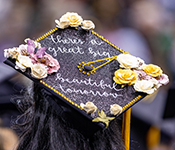
 On Friday, June 9, more than 4,000 family and friends from near and far gathered on the University of Washington campus to celebrate the Allen School’s 2023 graduates. The celebration commenced with a casual open house and meet-and-greet with faculty and staff in the Paul G. Allen Center and Bill & Melinda Gates Center. It culminated in a formal event in the Hec Edmundson Pavilion at the Alaskan Airlines Arena, where graduates made the brief journey across the stage to mark the start of a new journey as Allen School alumni. Read more →

‘Take advantage of the doors that open’: Allen School celebrates the Class of 2023
On Friday, June 9, more than 4,000 family and friends from near and far gathered on the University of Washington campus to celebrate the Allen School’s 2023 graduates. The celebration commenced with a casual open house and meet-and-greet with faculty and staff in the Paul G. Allen Center and Bill & Melinda Gates Center. It culminated in a formal event in the Hec Edmundson Pavilion at the Alaskan Airlines Arena, where graduates made the brief journey across the stage to mark the start of a new journey as Allen School alumni. Read more →
Allen School’s Husky 100 honorees give back to the UW community and beyond as scientists, educators, entrepreneurs and leaders
 Six Allen School students were recently named to the 2023 class of the Husky 100, an honor recognizing undergraduate and graduate students who are making the most of their time at the University of Washington. Husky 100 students make connections in and out of the classroom, making a positive impact on campus and in their communities. This year’s Allen School inductees are living those values, proving Huskies are stronger when in a pack. Read more →
“Go ahead and take that adventurous route”: Allen School professor Yejin Choi named 2022 MacArthur Fellow
NLP for all: Professor and 2022 Sloan Research Fellow Yulia Tsvetkov is on a quest to make natural language tools more equitable, inclusive and socially aware
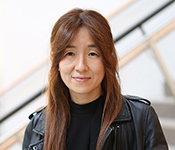
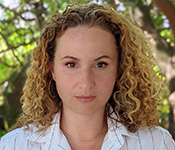 Less than a year after her arrival at the University of Washington, professor Yulia Tsvetkov is making her mark as the newest member of the Allen School’s Natural Language Processing group. As head of the Tsvetshop — a clever play on words that would likely stymie your typical natural language model — Tsvetkov draws upon elements of linguistics, economics, and the social and political sciences to develop technologies that not only represent the leading edge of artificial intelligence and natural… Read more →
Allen School’s Amy Zhang and Franziska Roesner win NSF Convergence Accelerator for their work to limit the spread of misinformation online
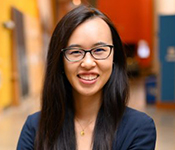
“Hey, check out this 450-pound dog!” Allen School researchers explore how users interact with bogus social media posts
Uncle Phil, is that really you? Allen School researchers decode vulnerabilities in online genetic genealogy services
Allen School’s latest faculty additions will strengthen UW’s leadership in robotics, machine learning, human-computer interaction, and more
The Allen School is preparing to welcome five faculty hires in 2019-2020 who will enhance the University of Washington’s leadership at the forefront of computing innovation, including robot learning for real-world systems, machine learning and its implications for society, online discussion systems that empower users and communities, and more. Meet Byron Boots, Kevin Lin, Jamie Morgenstern, Alex Ratner, and Amy Zhang — the outstanding scholars set to expand the school’s research and teaching in exciting new directions while building on… Read more →
Allen School and AI2 researchers unveil Grover, a new tool for fighting fake news in the age of AI
Yejin Choi recognized with Borg Early Career Award
Yejin Choi, a professor in the Allen School’s Natural Language Processing research group, has earned a 2018 Borg Early Career Award from the Computing Research Association’s Committee on the Status of Women in Computing Research (CRA-W). The annual award, which is named in honor of pioneering computer scientist Anita Borg, recognizes women in computing who have made significant contributions to the field through their research and activities that promote diversity.
When Choi joined the Allen… Read more →